How to Buy an Original Syrian Painting: The Complete Collector's Guide
6 September 2026
In February 2025, at Sotheby's first auction on Saudi soil, Louay Kayali's "Then What?" sold for $900,000 - a new record for the Aleppo-born painter, half again above its low estimate. Sitting in that room were collectors who had entered this market twenty years earlier with a single canvas bought from a small gallery in Damascus or Beirut. The road from first painting to headline bid starts with simple steps; only the beginner's mistakes are expensive.
Before you spend anything: know why you are buying
Collectors come in three kinds, and the kind determines the decision. Buyers driven by love can ignore the market entirely and take what stops their heart. Buyers with an investment eye need auction records and documented names. Most people sit in between: they want a painting they love that will not lose its value. Be honest with yourself here, because the seller's advice - and your budget - will change with your answer.
Read before you buy. The Atassi Foundation's open archive covers a century of modern Syrian art, and our piece on the most expensive Syrian paintings ever sold maps the names the market competes for today.
Where to buy: four channels, four logics
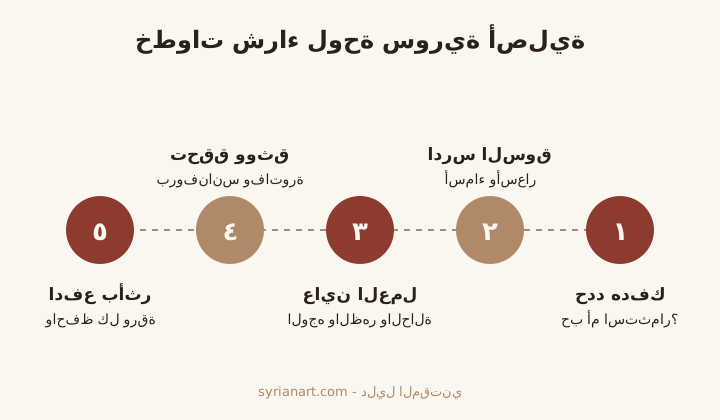
Specialist galleries. Galleries in Dubai, Beirut, Amman, and London formally represent Syrian artists, and some have reopened in Damascus. A gallery guarantees authenticity with its commercial name and lets you inspect at leisure. Prices are higher than buying direct, but the guarantee is included.
Auctions. Sotheby's, Christie's, and Bonhams regularly feature Syrian art in their Middle Eastern sales. Bonhams' November 2025 London auction alone brought £3.2 million and set records for works by Marwan Kassab-Bachi. Auctions suit buyers who have studied prices - and remember the premium adds roughly a quarter to the hammer.
Buying from the artist. Legitimate and common with younger artists, especially via Instagram and group shows. You get a better price and a direct relationship, but documentation becomes your job: ask for a signed certificate with the work's details.
Online platforms and dealers. Widest reach, weakest guarantees. Never wire a large sum to an unknown account against photographs, however tempting the painting. Our guide to where Syrian art sells today maps these channels city by city.
Inspecting the work
Take your time. Look from across the room, then from very close. Turn the painting over if permitted: the back talks - old exhibition stamps, gallery labels, the artist's own handwriting. Ask about year, medium, and condition, and request a written condition report when the price justifies it. Craquelure, damp damage, and past restoration all affect value, and all are detectable. For a serious sum, bring in an independent expert - see our guide to authenticating a Syrian painting.
Negotiating, paying, papering
Gallery prices are negotiable within polite limits; a 10-15% discount for a serious collector is customary. Pay in a way that leaves a trail - bank transfer or a signed receipt - and keep every paper: invoice, certificate, correspondence, even a photo of the painting hanging at the point of sale. These small papers become tomorrow's provenance, the difference between a painting that resells easily and one every buyer doubts.
Think past the purchase too. A large canvas needs professional transport, insurance, and a wall away from sunlight - see shipping art from and to Syria and caring for paintings in our climate.
The costliest mistake
It is not buying a fake - that is comparatively rare if you are careful. The common mistake is the rushed purchase, driven by fear of missing out. The Syrian market has been rising since 2024, sellers know it, and "another buyer is waiting" gets said every day. A good painting missed will be replaced by another; money spent on a poorly documented work rarely comes back. And if your budget will not reach an original by an artist you love, limited editions are an honorable entry - read originals, copies, and limited editions first.
Start small, document everything, and buy what you can live with on your wall for years. Everything else is detail you learn one painting at a time - more of it in the rest of the collector's guides.
FAQ
How much do I need to start collecting Syrian art?
Works on paper and pieces by emerging artists start at a few hundred dollars through galleries and online platforms. Oil paintings by established mid-career names typically run $3,000-20,000, while the modern masters now sell well beyond that at auction.
Is it better to buy at auction or from a gallery?
Each channel has its logic. A gallery gives you time to inspect the work, a direct relationship, and a guarantee backed by its name. An auction gives you price transparency and a documented result. Start with galleries, move to auctions once you know the price levels.
What is the single most important document to ask for?
A detailed invoice in the seller's name stating the artist, title, dimensions, medium, and year, together with any prior ownership papers or certificates. These documents are the foundation of provenance, which protects the painting's value at resale.