Famous Syrian Artists: The Essential List
6 September 2026
At Sotheby's Riyadh in 2025, a painting by Louay Kayali climbed to $900,000 - a record for any Syrian artist. Months later, Sara Shamma opened Syria's pavilion at the 2026 Venice Biennale with a solo exhibition on the Tower Tomb of Palmyra. Between that number and that pavilion lies a full century of Syrian art. This list compresses it into eighteen names across four generations.
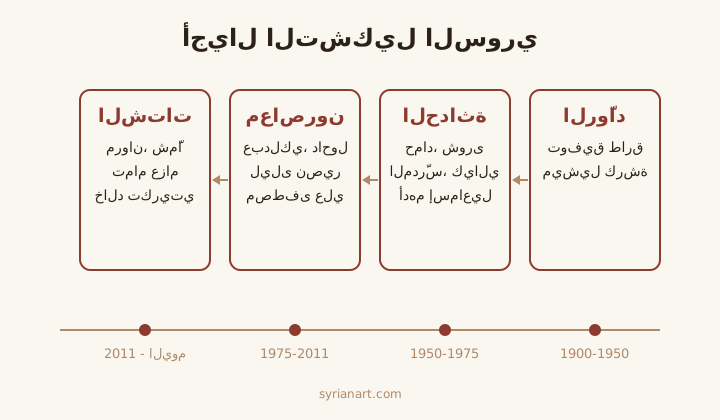
The pioneers
Tawfik Tarek (1875-1940) studied in Istanbul and at the Ecole des Beaux-Arts in Paris, then ran a Damascus studio that became a school in itself - documentary realism, portraits of Damascene notables, historical scenes. Michel Kirsheh (1900-1973), also Paris-trained, chose Impressionism instead; Elias Zayat trained in his studio.
The founding generation
Nasir Shoura (1920-1992) co-founded Atelier Veronese in Damascus in 1940 with Mahmoud Hammad (1923-1988), who later served as dean of the Faculty of Fine Arts and turned Arabic letters into pure abstract structure. Adham Ismail (1922-1963), born in Antakya and trained in Rome, is credited with the first serious Syrian move from realism toward arabesque-based abstraction; he died at forty. Fateh Moudarres (1922-1999), Aleppo-born and Rome- and Paris-trained, taught generations in Damascus; his stacked, Mesopotamian-masked faces became a national idiom. Louay Kayali (1934-1978) represented Syria at the 1960 Venice Biennale alongside Moudarres at twenty-six; his lottery vendors, shoe-shiners, and fishermen are now the most valuable canvases in the Syrian market. His full story is on the Louay Kayali profile.
The second modernist wave
Marwan Kassab-Bachi (1934-2016) left Damascus for Berlin in 1957 and became a professor at its academy of arts; his monumental faces put him in European museum collections before Arab ones. Elias Zayat (1935-2022) studied in Sofia, Cairo, and Budapest, co-founded the Damascus faculty, and fused Byzantine icon painting with Syrian legend. Nazir Nabaa (1938-2016) moved from political posters to the luminous, ornamented "Damascene women" cycles. Leila Nseir (1941-2023), a Latakia-born Cairo graduate, earned her place in the front rank with no gender asterisk - the body, motherhood, and sacrifice were her lifelong subjects. Asaad Arabi (b. 1941), Paris-based with a Sorbonne doctorate in aesthetics, paints the rhythms of the old Damascus he left.
The contemporaries
Youssef Abdelke (b. 1951) works in charcoal black and white - a fish, a knife, a child's shoe - still lifes that read as political elegies, made in Damascus. Mustafa Ali (b. 1956), sculptor from Latakia trained in Carrara, ran the art foundation that anchored Old Damascus's art scene for years. Safwan Dahoul (b. 1961) has painted his "Dream" series since the late 1980s: one woman, in white, black, and grey. Khaled Takreti (b. 1964), architect-turned-painter in Paris, reads the Syrian family with pop-inflected irony. Sara Shamma (b. 1975), working between London and Damascus, became the first Syrian artist to present a solo national pavilion at the Venice Biennale in 2026 - see the Sara Shamma profile. Tammam Azzam (b. 1980) went viral in 2013 with "Freedom Graffiti," Klimt's Kiss projected onto a shelled Damascus facade, and now builds large paper collages of the ruined city in exile.
How to use this list
Eighteen names, not a ranking - a first map. For the full chronology, start with the history of Syrian art; for where to see and buy, read Syrian art online; the rest of the site's files are in the articles index.
FAQ
Who is the most expensive Syrian artist at auction?
Louay Kayali, so far. A Kayali canvas reached $900,000 at Sotheby's Riyadh in 2025, overtaking the long-standing benchmark set by Fateh Moudarres ($374,500 at Christie's Dubai, 2010).
Who were the pioneers of Syrian modern art?
The first generation working before the 1950s: Tawfik Tarek (1875-1940), the academically trained realist, and Michel Kirsheh (1900-1973), who brought Impressionism from Paris to Damascus. The academic founding generation followed - Mahmoud Hammad, Nasir Shoura, and Adham Ismail.
Is Syrian art still made inside Syria, or has it all moved abroad?
Both. The Faculty of Fine Arts in Damascus and studios like Mustafa Ali's still work from inside the country, while many leading names operate from Berlin, Paris, Dubai, and London. Galleries and auction houses show both without distinction.