Syrian Women Artists: From Leila Nseir to Sara Shamma
6 September 2026
On 9 May 2026 the doors of the Syrian pavilion at the Venice Biennale opened onto a funerary tower - a reconstruction of the Palmyra tomb towers destroyed in the war, holding paintings, light, sound and scent. The work belongs to Sara Shamma, the first woman to lead Syria's pavilion with a solo presentation in the Biennale's history. A moment like this does not come from nowhere. Behind it stand eighty years of women who painted, etched and sculpted in a country that did not make it easy for a woman to practice art at all.
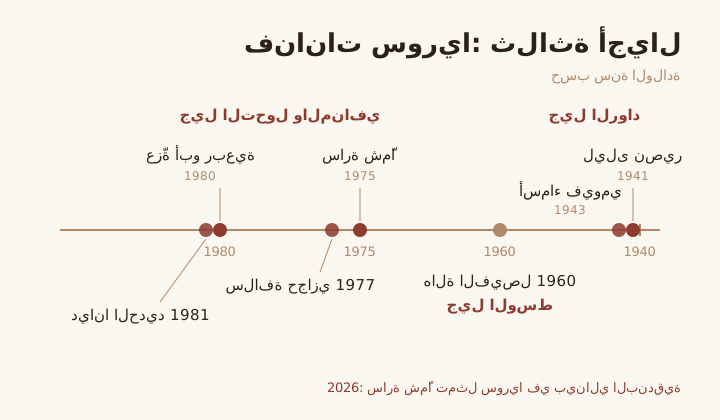
Leila Nseir: the pioneer who paid the price
Leila Nseir was born in Latakia in 1941 to a family that encouraged her studies. She traveled to Cairo, studied at the Faculty of Fine Arts and graduated in 1963, later teaching at the University of Damascus. Her subjects were the crushed human figure, the female body and motherhood, in a language close to that of her friend Louay Kayali - but with one extra question the men of her generation never asked: the position of women in Arab society. Anyone who reads our article on the most famous Syrian artists will notice how few women's names appear in that generation, which is exactly why sustaining a career across whole decades was an achievement in itself.
Nseir received the Syrian Order of Merit in 2018 and died in August 2023 in a care home in Latakia. A year after her death, Ayyam Gallery in Dubai staged a retrospective of her work titled Estoria.
Asma Fayoumi: abstraction from the heart of Damascus
Two years after Nseir, Asma Fayoumi was born (1943). She studied at the Faculty of Fine Arts in Damascus under the Italian Guido La Regina, alongside classmates who became major names, such as Assad Arabi. Her solo exhibition in Damascus in 1966 established her presence early, and from the 1960s onward she remained a fixture of the Damascus scene, moving from abstractions of the city's streets to a symbol-laden expressionism.
Broad international recognition came late but came strong: her work entered Taking Shape, the survey of Arab abstraction that toured American museums between 2020 and 2022, then the 2023 Whitechapel Gallery exhibition in London on women artists and global abstraction. Her works are today in collections including the National Museum of Damascus and the Barjeel Art Foundation.
The middle generation: Hala Faisal
Between the pioneers and the war generation stands a cohort that trained in Damascus and left early for the wider world. Hala Faisal, born in Homs in 1960, graduated from the Faculty of Fine Arts in Damascus in 1983 and continued between Paris, Moscow and New York, painting the human body with a boldness unfamiliar in her generation. Her itinerant path across languages and capitals prefigured what would become the rule for the next generation: the Syrian woman artist who works from more than one country.
Sara Shamma: from Damascus to Venice
Sara Shamma was born in Damascus in 1975 and graduated first in her class from the painting department of the Faculty of Fine Arts, University of Damascus, in 1998. Her first international recognition came in 2004, when she won fourth prize in the BP Portrait Award at the National Portrait Gallery in London for a self-portrait. She left Syria because of the war, obtained the UK's Exceptional Talent visa in 2016, then returned to Damascus in late 2024 after eight years in London.
Her Biennale project, The Tower Tomb of Palmyra, curated by Yuko Hasegawa, is a free-standing tower inspired by Palmyrene funerary architecture that argues from within for the restitution of antiquities looted during the war. Her page on this site follows her career in detail.
The generation the war carried into the world
Sulafa Hijazi (Damascus, 1977) moved from theater and animation into contemporary art, best known for Ongoing, a series of digital images mostly produced in Damascus between 2011 and 2015 that circulated worldwide before she settled in Berlin. Azza Abo Rebieh (1980), a 2002 graduate of the printmaking department at the University of Damascus, saw the British Museum acquire three of her etchings, smuggled out through Beirut; detained in 2015, she drew the faces of her cellmates with a pencil she wrested from her jailers, and today works from Beirut. And Diana Al-Hadid, born in Aleppo in 1981 and taken to Ohio as a child, became one of America's most prominent sculptors with works resembling eroded cities, working from Brooklyn.
Some names we deliberately left out despite how often they are linked to Syria: Etel Adnan, for instance, is a Lebanese-American artist, not a Syrian one.
What does this lineage say?
The thread running from Nseir to Shamma is not style - between 1960s expressionism, etching, digital work and sculpture the distances are vast. The thread is cost: each generation paid for its presence in its own way, one paying the price of being a woman who painted for a living, another paying the price of war, prison and exile. For the wider frame, the full panorama is in the history of modern Syrian art, and the rest of our coverage sits in the articles index.
Other names deserve their own files in time, from the painters still working in Damascus and Aleppo to the new-media artists of the diaspora capitals. This page opens the door; it does not close it.
The market has begun catching up with this history. Fayoumi at Whitechapel, the British Museum's acquisitions of Abo Rebieh, Shamma's Venice pavilion - all signal that work by Syrian women artists is moving from the margin of the story to its center, and prices usually move with it. Whoever buys today buys before that correction is complete.
FAQ
Who is the first Syrian woman artist to reach the Venice Biennale with a solo presentation?
Sara Shamma. She was selected to represent Syria at the 61st Venice Biennale (9 May - 22 November 2026) with a solo work titled The Tower Tomb of Palmyra, curated by Japan's Yuko Hasegawa - the first woman ever to lead the Syrian pavilion with a solo show.
Who is the pioneer of modern Syrian women's art?
Leila Nseir (1941-2023), from Latakia, a 1963 graduate of the Faculty of Fine Arts in Cairo. She is described as the most prominent Syrian woman artist to sustain a full career at a time when women rarely continued in the profession, and she received the Syrian Order of Merit in 2018.
Are works by Syrian women artists held in international museums?
Yes. The British Museum acquired three etchings by Azza Abo Rebieh, Asma Fayoumi's work has been shown at Whitechapel Gallery in London and in American museums within surveys of Arab abstraction, and Diana Al-Hadid's works are held in the collections of major American institutions.