The Atassi Foundation: The Archive of Modern Syrian Art
6 September 2026
In the attic of a family bookshop in Homs, in 1986, two sisters hung paintings on the walls and called the place a gallery. There was not a single private gallery in the entire city before that day. Four decades later, that small initiative carries a name every researcher in Arab art knows: the Atassi Foundation, holder of the most comprehensive private collection dedicated to modern and contemporary Syrian art.
From gallery to foundation
The gallery Mouna and Mayla Atassi founded above the family bookshop grew fast: it moved to a larger space in the same building, then made its decisive move in 1993, relocating to the Rawda district of Damascus. There it became one of the country's most important exhibition platforms, presenting the major names - from Fateh Moudarres to Abdullah Murad and Ahmad Durak Sibai - within an active program of exhibitions, talks and publications.
Mouna Atassi had been planning to turn the venture into a non-profit space since 2010, and had actually found a site in Damascus. Then came March 2011. The gallery closed its doors, and the family and the collection moved to Dubai - where the foundation was formally born in 2016, an independent non-profit run today by Shireen Atassi, Mouna's daughter.
What does the foundation preserve?
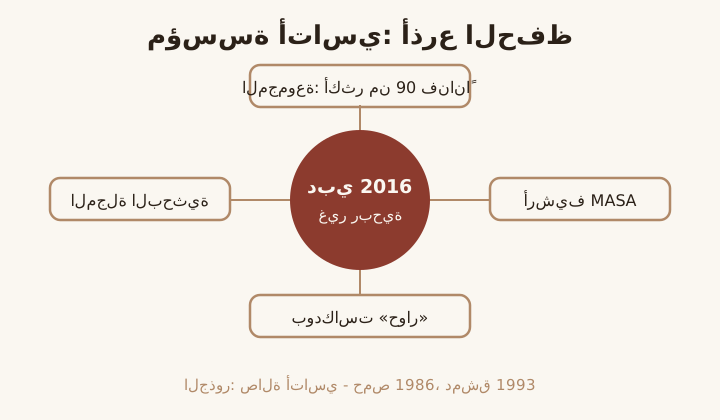
The collection covers nearly a full century: from the pioneers of the early twentieth century to contemporary work, with pieces by more than ninety Syrian artists. When the Concrete space at Alserkal Avenue in Dubai opened in 2017, the exhibition of the Atassi collection was its inaugural event - a signal of the weight it had come to carry.
But the paintings are only half the story. The other half is paper: the Modern Art Syria Archive (MASA) gathers exhibition catalogues from the 1950s and 1960s, artists' correspondence, photographs and press clippings - material that was scattered in threatened homes and storerooms, some of it in cities destroyed by the war. Add to that The Journal, a research publication carrying studies of Syrian art, and the podcast Hiwar, which records artists' testimonies in their own voices.
Why does this matter to the collector and the researcher alike?
A market without institutional memory is a fragile market. When an auction sells a painting by Fateh Moudarres or Louay Kayali for hundreds of thousands of dollars - and it has happened; see the market scene after 2024 - the documentation supporting the work's attribution and exhibition history usually passes through archives like the one Atassi is building. The foundation does not buy or sell on anyone's behalf, and that is precisely what gives its work its weight: a reference with no commercial interest.
For the researcher, the difference is existential. The history of Syrian art has not yet been written in full, and the primary material it will be written from was on its way to being lost. What the foundation is doing resembles what historians have done after every great war: gathering the fragments before they turn into a void.
Its place on the map
In Syria's institutional landscape, Atassi occupies the third side of a clear triangle: Ayyam Gallery built the international market, the Damascus galleries preserved the local presence, and Atassi preserved the memory. And with life returning to the domestic scene after 2024, and the new official representation at the 2026 Venice Biennale, the archive gains added value: any coming revival will need to know what it is building on. More of the site's material is in the articles index.
FAQ
What is the difference between Atassi Gallery and the Atassi Foundation?
The gallery was a commercial venture: sisters Mouna and Mayla Atassi founded it in Homs in 1986, it moved to Damascus in 1993, and it closed when the uprising began. The foundation is a non-profit entity established in Dubai in 2016 whose mission is preservation, research and publishing - not selling.
Can the foundation's collection be viewed?
Yes. A large part of the collection and archive is available digitally through the foundation's website and through Google Arts and Culture, in addition to periodic exhibitions the foundation stages or loans to international museums and shows.
What does the MASA archive contain?
The Modern Art Syria Archive (MASA) gathers the documents of the Syrian art movement: old exhibition catalogues, correspondence, photographs, press clippings and printed matter hard to find anywhere else - the raw material from which the history of Syrian art will be written.