Nazir Nabaa: The Colors of Damascus
6 September 2026
At Christie's Dubai in 2017, Nazir Nabaa's Untitled (Three Ladies) climbed to 87,500 dollars, his documented record to this day. Three women with calm Damascene features, fabric worked down to the last thread, and gold gleaming in the background like a wall of icons. Anyone who knows the man's beginnings sees the irony: the painter who ended in this chromatic opulence started out drawing resistance posters in black and white.
From a working-class neighborhood to Cairo
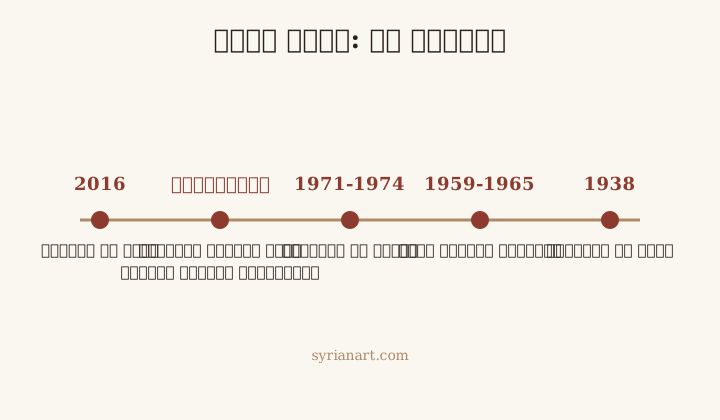
Nazir Nabaa was born in Damascus in 1938 to a modest family - his father worked in farming and other trades, his mother in embroidery. The mother's threads and colors would later return in his paintings, unmistakably.
He traveled to Cairo and studied at the Faculty of Fine Arts between 1959 and 1965, during the years of the Syrian-Egyptian union and after. There he met fellow artist Shalabieh Ibrahim, who became his lifelong partner in marriage and in the studio. He returned to Syria as an art teacher, and his first phase was committed realism: peasants, workers, tired faces painted with a heroic charge.
The political poster: artist of the cause
In the late 1960s and early 1970s Nabaa became one of the most important political poster designers in the Levant. He drew for Palestine and the resistance and helped shape the visual identity of that era's causes with sharp lines and condensed symbols. These graphic works, some printed in the tens of thousands, are studied today as artistic and political documents at once, and institutions such as the Dalloul Art Foundation in Beirut hold examples.
Paris, then the return to Damascene gold
Between 1971 and 1974 he completed his studies at the Ecole nationale superieure des Beaux-Arts in Paris. He then returned to Damascus as a professor at the Faculty of Fine Arts, University of Damascus, where generations of Syrian artists graduated under him.
And in the studio came the great turn. The heroic realism receded in favor of a pictorial world of his own: the Damascene woman as icon, flowers exploding with color, fabrics and jewelry painted with an embroiderer's patience, and gold backgrounds summoning Palmyra and the Eastern icon together. This was not a retreat from commitment so much as its redefinition: preserving the visual memory of an entire city inside the painting.
What does collecting Nabaa mean today?
Nabaa died in Damascus in 2016, and his works are spread across Syrian, Lebanese and Gulf private collections and institutions such as Dalloul and Atassi. At auction his work appears regularly at Christie's, Sotheby's and Bonhams within Middle Eastern art sales, and the practical references for tracking his results are Artsy and MutualArt.
Three practical notes for the new collector. First: period sets the price - the large oils from the Damascene women phase are the most expensive, while works on paper and studies are far cheaper and make a reasonable entry point. Second: documentation is decisive, and the preferred source is works with a clear exhibition history or those published in his books and retrospectives. Third: Nabaa's market is quieter than those of Louay Kayali and Fateh Moudarres - compare their numbers in the history of Syrian art - and that is precisely why some collectors see him as an opportunity not yet priced to the scale of his standing.
Nabaa's place in the Syrian narrative is clear: he is the bridge between the founding generation of Adham Ismail and Mahmoud Hammad and the contemporary generations who broke every rule, such as Sabhan Adam. Anyone who wants to understand how Syrian art moved from the impressionist scene of Michel Kurcheh to the large symbolic canvas need only trace Nabaa's path alone: Cairo, the poster, Paris, then the gold of Damascus.
More artist files in the articles index.
FAQ
Who was Nazir Nabaa, in brief?
A Syrian painter born in Damascus in 1938 who died there in 2016. He studied at the Faculty of Fine Arts in Cairo and then at the Ecole nationale superieure des Beaux-Arts in Paris, and taught for decades at the Faculty of Fine Arts, University of Damascus. He is counted among the pioneers of Syrian modernism.
What distinguishes Nazir Nabaa's paintings?
His early phase was committed realism tied to the political poster and the Palestinian cause. From the 1970s he turned to a pictorial world of his own: Damascene women with icon-like features, flowers, finely worked jewelry and fabrics, and gold backgrounds recalling Palmyrene art and Eastern icons.
What do his works fetch at auction?
His documented record is 87,500 dollars for Untitled (Three Ladies) at Christie's Dubai in 2017, and his large oils typically trade in the tens of thousands of dollars depending on size and period.