Where to See Syrian Art in the World's Museums
6 September 2026
In the permanent galleries of Mathaf, the Arab Museum of Modern Art in Doha, hangs Fateh Moudarres's "The Last Supper" from 1965: square, earth-colored faces around a nearly bare table. Anyone who wants to stand in front of the origins of Syrian modernism today rarely travels to Damascus. They go to Doha, Sharjah or London. This guide is the map.
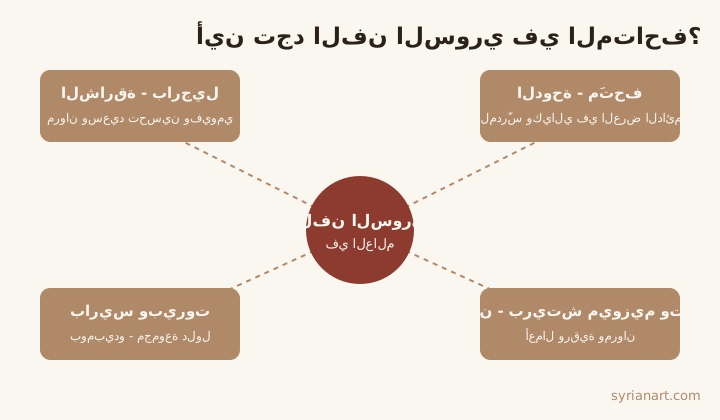
Doha: Mathaf
Mathaf's collection exceeds six thousand works and is the broadest museum reference for Arab modernism. Syrians sit at its core: Moudarres with museum-scale canvases, and a Louay Kayali painting in the permanent display. The museum's online encyclopedia of Arab artist biographies is a serious research tool even if you never board a plane. More detail in our piece on Syrians at Mathaf and Barjeel.
Sharjah: the Barjeel Art Foundation
Founded by Sultan Sooud Al Qassemi in 2010, Barjeel holds over a thousand modern and contemporary Arab works, including Fateh Moudarres, Said Tahsin, Asma Fayoumi and Marwan - whose "The Three Palestinian Boys" (1970) is one of its best-known pieces. Barjeel is a lending collection rather than a fixed museum, and its full database is online with high-resolution images.
London: the British Museum and Tate
Since 2009 the British Museum has built, through its CaMMEA acquisition group, a body of close to three hundred works on paper from the Middle East and North Africa, and in 2011 it decided to acquire work by Syrian artists documenting the war years. Marwan's prints and works on paper are held there too. At Tate Modern, Marwan enters the permanent collection - a position no other Syrian artist of his generation reached.
Paris: Centre Pompidou
The Pompidou holds Marwan and lists him in its official artist records. His presence in both the French and British flagship institutions explains part of his auction trajectory - a story we tell in Syrian art history and in the most expensive Syrian artworks.
Beirut and Damascus: the closer circle
The Dalloul Art Foundation in Beirut keeps around three thousand Arab works with a substantial Syrian core - it has its own article. The National Museum of Damascus remains the only place to see certain works inside the country itself, though its modern art wing has had the least restoration attention.
Planning a visit
Rule one: never assume the work is on the wall. Search the collection database on the museum's site (the single name "Marwan" is enough at Tate and the Pompidou); some museums grant study-room appointments for works in storage. Rule two: watch temporary exhibitions - they are what bring works on paper out of the drawers. Rule three: start with the digital collections. Mathaf, Barjeel and Dalloul all publish their holdings online free, and together they are a complete education in Syria's major artists before you buy or travel. Our collector's guide to buying Syrian art picks up from there.
FAQ
Is there a single museum dedicated to modern Syrian art?
No. Modern Syrian art is spread across regional museums like Mathaf in Doha, private collections like Barjeel in Sharjah and the Dalloul Art Foundation in Beirut, plus scattered holdings in major Western museums. The Atassi Foundation archives the field but is not a permanent museum.
Where can I see original works by Marwan Kassab-Bachi?
Marwan is the most widely collected Syrian artist in Western institutions: Centre Pompidou in Paris, Tate Modern and the British Museum in London, the Carnegie Museum of Art in Pittsburgh and the Museum of Contemporary Art Chicago. Displays rotate, so check each museum's online collection before visiting.
Are these works on permanent display?
Rarely. Museums show a fraction of their holdings and rotate the rest. Works on paper - like the British Museum's Syrian acquisitions - appear only in temporary exhibitions because of light sensitivity. Search the museum's online collection database or write to the department before you travel.