The Syrian Art Scene After 2024 - The Return to Damascus
6 September 2026
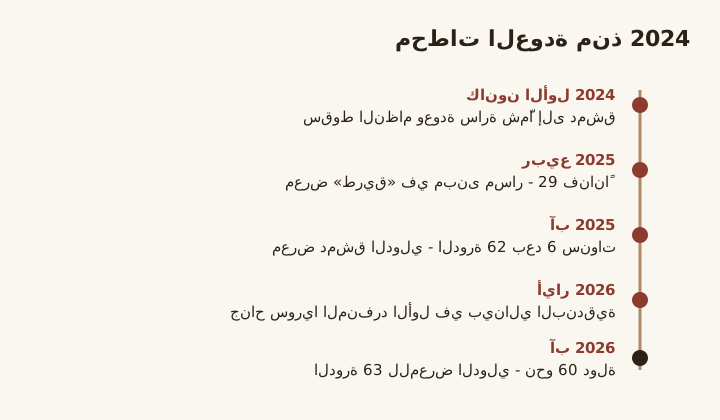
In spring 2025, Damascene visitors stood inside the abandoned Massar building in the center of the capital before the work of 29 young Syrian artists. The exhibition was called Madad (Path), organized by the Madad Art Foundation - the first major art event in Damascus since the fall of the regime on 8 December 2024. The building itself was nearly seized by an armed group weeks after liberation, and the art community protested publicly until it was returned. That is how the new chapter of Syrian art began: a real joy of return, and a fragility still guarded by people's voices rather than institutions of law.
The compass reversed
For thirteen years the arrow of movement pointed outward - as we detailed in the diaspora years. Since December 2024 the direction has flipped. The clearest example is Sara Shamma: a 1998 graduate of the Faculty of Fine Arts, she left for London in 2016 on an Exceptional Talent visa, then packed up her studio and returned to Damascus for good in late 2024, weeks before the great turn. Her return was not merely symbolic - months later came the announcement that put her name at the front of the scene.
Palmyra in Venice
At the 61st Venice Biennale (9 May - 22 November 2026), Syria stands for the first time in its history with a national pavilion devoted to a single artist - a departure from the format of previous Syrian pavilions, which grouped Syrian artists with international guests. In the open courtyard of Iuav University in Venice, Shamma has built a reconstruction of a Palmyrene funerary tower fifteen meters high, visible from the water before arrival, holding 18 new paintings with sound, light and scent, curated by Japan's Yuko Hasegawa and commissioned by the Ministry of Culture. The work, The Tower Tomb of Palmyra, also argues for the restitution of antiquities looted during the war years - a political and artistic statement at once, addressed to the world from a country reintroducing itself.
The city opens its doors
On the ground, signs of recovery stack one on top of another. The Damascus International Fair - the country's biggest public event since 1954 - returned with its 62nd edition on 27 August 2025 after a six-year halt, with 800 companies under the slogan "Syria welcomes the world", and the 63rd edition opened in August 2026 with around 60 countries. Al-Khan on the Street Called Straight has returned as a cultural space after remaining a deferred dream for nearly two decades. And the historic gallery names, above all Atassi - which closed its Damascus doors when the uprising broke out in 2011 - are back to talking about a presence inside the country, not just around it.
Shamma herself summed up the meaning in her interview with The Art Newspaper on the eve of the opening: this is a chance that will not come again - the chance for an artist to take part in rebuilding her country rather than merely documenting its ruin. Between her Palmyrene tower in Venice and her studio back in Damascus runs a single straight line.
What remains unresolved?
The picture is not entirely rosy, and anyone writing about this period in the register of triumph betrays it. The artistic infrastructure is exhausted: the Faculty of Fine Arts came out of the war with a drained faculty, the National Museum suffered a theft of antiquities in 2025, and the economy can barely carry a domestic art market. Most of the purchasing power for Syrian art remains external - in the London, Dubai and Riyadh auctions that set their records far from Damascus, from Louay Kayali's 900,000 dollars in February 2025 to the Bonhams sale that passed 3.2 million pounds in November 2025.
And the diaspora itself will not all come back. An entire generation built lives and studios in Berlin and Paris, and the relationship with the homeland will remain a bridge rather than a final return - in the manner of Marwan Kassab-Bachi, who stayed Syrian in Berlin for sixty years. The likely shape of the coming scene is bipolar: Damascus as the center of production and memory, the diaspora capitals as the centers of market and distribution, and artists moving between the two banks with passports heavier than their suitcases.
What deserves watching?
For anyone following this scene as a collector or an observer, three threads deserve attention. First: the Madad generation - twenty-nine young names shown together at a founding moment, some of whom will be the stars of the next decade at today's prices. Second: the movement of returning institutions, from Al-Khan to the programs of private foundations, because the return of infrastructure historically precedes the return of the market. Third: the effect of the Venice pavilion on pricing - national solo presentations have historically lifted the auction presence of their country's artists in the sales that follow.
A second founding moment
For all that, what has been happening since 2024 is the closest thing to a founding moment Syrian art has lived through since the opening of the Higher Institute in 1960. Institutions are being rebuilt, artists are negotiating a new social contract with the state and the public, and the world is watching with an attention Syrian art never received in peacetime. To measure the distance traveled, read the full century of Syrian art - or the 1960s decade, which the present moment is trying to bring back to life. More in the articles page.
FAQ
What was the first major art exhibition in Damascus after the fall of the regime?
Madad (Path), organized by the Madad Art Foundation in spring 2025 inside the abandoned Massar building, with 29 emerging Syrian artists. It was widely described as the announcement of a rebirth for the capital's creative scene.
What represents Syria at the 2026 Venice Biennale?
A solo national pavilion by artist Sara Shamma titled The Tower Tomb of Palmyra, commissioned by the Ministry of Culture and curated by Yuko Hasegawa, from 9 May to 22 November 2026: a 15-meter Palmyrene funerary tower holding 18 new paintings - the first solo-artist Syrian participation in the Biennale's history.
Has the Damascus International Fair really returned?
Yes. The 62nd edition opened on 27 August 2025 after a six-year halt, with 800 companies under the slogan 'Syria welcomes the world', and the 63rd edition opened in August 2026 with around 60 countries taking part.