Is Syrian Art a Good Investment? The Numbers, Honestly
6 September 2026
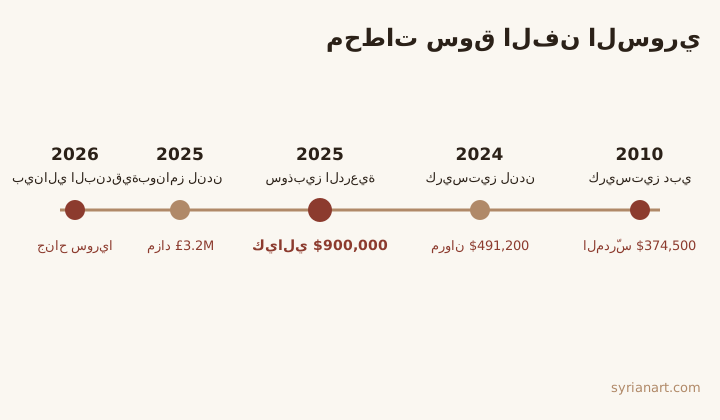
In October 2010 a bidder at Christie's Dubai paid $374,500 for an untitled 1967 canvas by Fateh Moudarres. At the time it looked like a permanent ceiling for Syrian art. Fifteen years later, in February 2025, Louay Kayali's Then What? sold for $900,000 at Sotheby's first auction on Saudi soil. Read only those two numbers and Syrian art looks like the trade of the decade. The truth is more complicated, and worth stating plainly.
What the documented numbers say
The climb at the top is real. Kayali's record alone rose two and a half times within eight months: $341,200 for Fisherboy at Bonhams in June 2024, then $900,000 in Diriyah. Marwan Kassab-Bachi set his record of $491,200 at Christie's London in October 2024. And on November 25, 2025, Bonhams's Middle Eastern sale totalled £3.2 million with Syrians among its strongest performers: a world record for Naim Ismail at £140,100 against a £40,000-60,000 estimate, and a works-on-paper record for Marwan. The full table is in the most expensive Syrian art.
There is also what dealers call institutional lift. Syria returns to the Venice Biennale in 2026 with a national pavilion given over to a single artist, Sara Shamma, and her installation The Tower Tomb of Palmyra (May 9 to November 22, 2026). Institutional presence of that kind usually precedes serious collector attention.
What the numbers leave out
The documented rise concerns a very narrow slice: major oils by the founding modernists, with clean ownership histories, passing through international auction houses. That slice is scarce by nature; the artists are dead and their output finite. The average canvas by a living Syrian painter trades at prices that have barely moved, and may find no buyer at all when you decide to sell.
Then liquidity. A stock sells at the press of a button. A painting needs an auction house willing to take it, the right season, a seller's commission, and a buyer's premium on the other side that depresses what reaches you. A year can pass between deciding to sell and receiving the money. Whoever buys into post-record headlines may wait years to break even.
Finally, forgery, the risk that cannot be overstated. A rising market, dead artists, archives scattered by war: perfect conditions for false attributions. Documentation is your only defence, and reading provenance explains how to check it line by line.
So what should you actually do?
Rule one: buy what you want to live with. If it appreciates, that is a bonus; if not, you own something that matters to you. Entering this market as a pure speculator means playing a game others have professionalized for decades.
Rule two: documentation before signature. An invoice, an ownership history, an independent expert opinion when in doubt. A small documented work beats a large doubtful one at any price.
Rule three: know the channels. International auction houses, specialist galleries in Dubai, Beirut and London, online platforms: each has its own logic and costs, mapped in where Syrian art sells today. And before your first bid, read how art auctions work so the buyer's premium does not surprise you.
Rule four: study the artist, not the price. The profiles of Louay Kayali and Fateh Moudarres explain why the world pays for these two names in particular. Knowledge here is not cultural garnish; it is the spread between buyer and seller.
The unvarnished conclusion: at its peak, Syrian art is a rising and verifiably rising asset; at its base, it is an illiquid, high-risk market. Buy with knowledge, patience and genuine attachment to the works and you hold the best odds of getting both pleasure and value. Buy the headlines and you pay for them. More in the articles index.
FAQ
Are Syrian art prices actually rising?
At the top, verifiably yes: Louay Kayali's record jumped from $341,200 in June 2024 to $900,000 in February 2025, and the Bonhams sale of November 2025 set several world records for Syrian modernists. That applies to documented masterworks by the founding generation, not automatically to the rest of the market.
How much do I need to start collecting?
Works on paper and pieces by living Syrian artists sell at auction and in galleries for a few thousand dollars, sometimes less. The realistic entry point is a documented work within your budget from an accountable source, not a six-figure modernist canvas.
What are the biggest risks?
Forgery first: a rising, thinly documented market is ideal territory for falsely attributed works. Then liquidity: selling a painting can take months or years, with heavy fees. Then taste: one generation's rise is not guaranteed to continue.