Diaspora Scenes: Syrian Art in Istanbul and Berlin
6 September 2026
In the Yeldegirmeni neighborhood of Kadikoy, on the Asian side of Istanbul, there is a three-story building where you hear more Arabic than Turkish. Studios, a darkroom, a recording studio, an exhibition space, and coffee always on the stove. This is arthere - the place that since 2014 has served as the living room of Syria's artists in Turkish exile. Two thousand kilometers away, in Berlin, another team works on an entirely different project: indexing the artists of a whole country scattered across forty states.
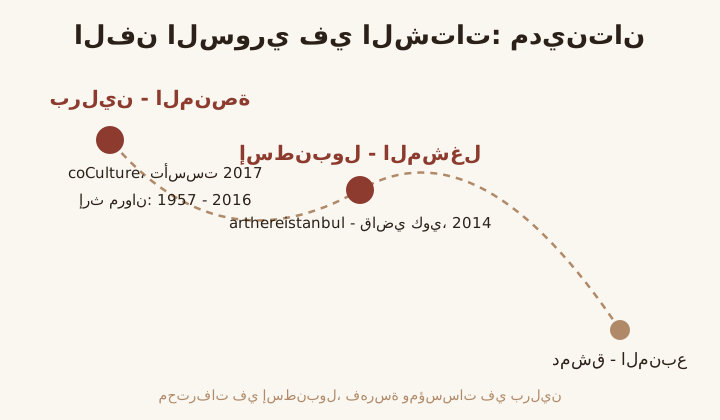
The Syrian diaspora did not produce one artistic community but two scenes, different in mood and in function. Istanbul is a workshop; Berlin is a platform.
Istanbul: the workshop
When photographer Omar Berakdar reached Istanbul in 2012, he found what hundreds of Syrian artists found: a giant city with no place to work. No studio, no community, no wall to hang a piece on. The answer was arthereistanbul in 2014 - a space founded by Syrian artists for Syrian artists, which then widened naturally to include Turks and foreigners, until it became one of the venues of the 17th Istanbul Biennial.
The deeper idea of the place is that it does not resemble a gallery: nobody represents anybody, and no cut of sales passes through it in any strict commercial sense. It is a meeting and production point - the place where works get made before they travel to galleries in London and Dubai. And with the mounting economic pressures on Syrians in Turkey, its role as a social safety net has become as important as its artistic one.
Berlin: the platform and the legacy
Berlin is another case. The city received the largest bloc of Syria's artists in Europe after 2015, but it was not virgin ground - it held a legacy named Marwan.
Marwan Kassab-Bachi, born in Damascus in 1934, arrived in Berlin in 1957 and studied painting at the Hochschule fur Bildende Kunste under Hann Trier, a classmate of the generation of Baselitz and Schonebeck. He climbed the city's artistic ladder step by step: professor at the University of the Arts from 1980 until his retirement in 2002, then the first Arab member of the Akademie der Kunste in 1994. His huge dissolving faces, suspended between East and West, became landmarks of contemporary German painting, and until his death in 2016 he remained a living bridge between Damascus and Berlin.
On that ground the new generation built. Artist Khaled Barakeh - a graduate of the Faculty of Fine Arts in Damascus and the Stadelschule in Frankfurt - founded the non-profit coCulture in 2017 and launched from it the Syria Cultural Index: a database tracking Syrian artists scattered around the world and connecting them with institutions and opportunities, alongside the Syria Biennale initiative and support programs for the displaced cultural sector.
What does all this mean for the home scene?
The diaspora is no longer an annex to the Syrian scene - it has become half of it. The names that set auction prices today work from Berlin, London, Dubai and Paris, and the institutions that document and index work from outside the borders, from the Atassi Foundation in Dubai to coCulture in Berlin. Even Ayyam Gallery, which internationalized this art in the first place, did it from exile.
After 2024 the question of return opened up. Some Istanbul residents have actually visited Damascus, and the city's galleries have begun showing works shipped from abroad, while the whole scene faces a test: will the energy accumulated in the exiles flow back into the interior, or will the geography stay double for another generation? Our article on Syrian art after 2024 follows that question, and Syria's pavilion at the 2026 Venice Biennale offers the first official answer to it. More in the articles index.
FAQ
What is arthereistanbul, and can it be visited?
A non-profit art space founded by Syrian photographer Omar Berakdar in 2014 in the Yeldegirmeni neighborhood of Kadikoy, on the Asian side of Istanbul. It occupies three floors holding exhibition spaces, studios, a recording studio and a darkroom, and it is open to visitors with regular exhibitions and events.
What does coCulture do in Berlin?
Founded by artist Khaled Barakeh in 2017 as a non-profit supporting displaced artists, its most prominent project is the Syria Cultural Index - a database gathering Syrian artists scattered around the world - alongside the Syria Biennale initiative and other support programs.
Why is Marwan Kassab-Bachi considered the father of the Berlin scene?
Because he preceded everyone by half a century: he arrived in Berlin in 1957, studied there, became a professor at the University of the Arts from 1980 to 2002, and in 1994 the first Arab member of the Akademie der Kunste. His presence gave the Syrian artists arriving after 2011 a precedent, a reference and legitimacy.