Where Syrian Art Sells Today: Auction Houses, Galleries and Platforms
6 September 2026
In the New Bond Street saleroom in London, on the evening of 25 November 2025, Bonhams' Middle Eastern art auction passed three million pounds sterling, and the Syrian paintings were among the strongest lots offered. At almost the same moment, Dubai galleries were opening exhibitions of Syrian artists, and online platforms were showing their works to buyers anywhere. The Syrian art market today is not one address but a network of channels, each with its own audience, prices and rules.
Auction houses: the top of the pyramid
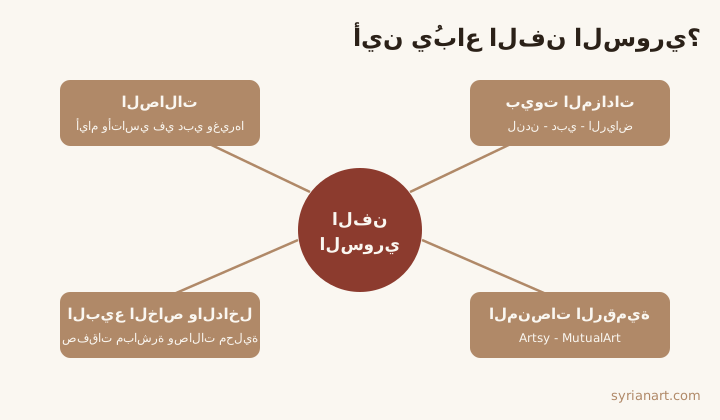
Christie's, Sotheby's and Bonhams are the channels that set the records and document them. Christie's Dubai opened the door in 2006 and set Fateh Moudarres's historic number in 2010. London became, over the past decade, the main stage for modern Arab art sales, and Bonhams in particular kept presenting Syrians until its auction became a twice-yearly checkpoint on the market. Then Riyadh entered the picture: Sotheby's first auction in Saudi Arabia, in February 2025, carried Louay Kayali's record of 900,000 dollars. All these numbers are detailed in the most expensive Syrian paintings ever sold, and the buying mechanics themselves in how art auctions work.
Galleries: where careers are built
An auction sells a moment; a gallery builds an artist over years. Ayyam Gallery, founded by Khaled and Juhaina Samawi in Damascus in 2006, moved its base to Dubai as the war intensified, taking dozens of Syrian artists and thousands of works with it, and remains one of the most active exhibitors of Syrian art in the Alserkal arts district. And the venerable Damascene Atassi Gallery became, in 2015, the Atassi Foundation in Dubai: a collection of around five hundred works by more than eighty Syrian artists, plus research and publishing activity that serves the whole market even if selling is not its primary business.
Buying from a gallery suits the beginner better than the auction room. The price is stated, there is time to ask and compare, and a gallery that respects its name stands behind what it sells. It is also where you buy the work of living artists at primary prices, before their work enters the resale market.
Digital platforms and the other channels
Artsy, MutualArt and their peers changed how people research before they changed how people buy: results records for every artist, works offered by galleries in dozens of cities, and inquiries sent with a single message. For the Syrian collector in the diaspora, these platforms are a practical window onto a market that once required travel and connections. One golden rule stands: the platform is a display intermediary, and verifying the work and its history is your responsibility - our guide to reading provenance lays out the steps.
Then there is the oldest and most opaque channel: private sale, collection to collection, through intermediaries or directly. Its prices are unpublished, large deals close in silence, and it is the playing field of people who have known each other for decades - not the place for first steps.
Which channel suits you?
The answer starts from your budget and your level of experience, not from your ambition. Someone with a few hundred to a few thousand dollars will find what they need on the digital platforms and among young artists at the galleries, where prices are stated and the risk is limited in size. Someone with tens of thousands who wants modern works by established names should go through the specialist galleries and the Middle Eastern art auctions, with all the catalogue-reading and condition reports that entails. The major works of the pioneers are the arena of those who possess knowledge before money - and who hire an independent art advisor without flinching at the fee.
Whatever the channel, ask the same questions before paying. Where did the work come from, and what is its ownership history? Does the seller provide an invoice in their legal name? What is the return policy if a defect in attribution or condition is proven? A reputable gallery answers without hesitation, an auction house puts the answers in its catalogue, and a seller who dodges the question has effectively answered it.
One note remains on the cultural sensitivity of the Syrian market specifically: part of what is on offer left the country during the war under circumstances of varying clarity. Asking about a work's route out is not curiosity but due diligence, and the serious channels expect the question and respect whoever asks it.
And inside Syria?
The war scattered the Damascus scene that in the 1960s and 1970s was the heart of the Arab art movement - the days when Fateh Moudarres opened his studio to students and Louay Kayali exhibited in the city's galleries. The galleries inside the country are working again at an uneven rhythm, with prices far below those abroad - which some collectors read as opportunity and others as a documentation risk. Syria's return to the 2026 Venice Biennale with Sara Shamma's pavilion, The Tower Tomb of Palmyra, has brought institutional light back to the scene, and history says institutional light precedes commercial movement.
Do not forget the diaspora itself as a fourth, informal channel. In Istanbul, Berlin, Paris and Montreal, Syrian artists sell directly from their studios or through small group shows, at primary prices and with a personal relationship no auction room offers. Buying a work from a living artist's studio is the cleanest provenance possible: the chain begins with you.
The practical takeaway: start by watching on the platforms, learn in the galleries, bid at auction when your knowledge matures - and before all of that read is Syrian art a good investment?. The rest of the market files are in the articles index.
FAQ
What is the difference between buying from a gallery and buying at auction?
A gallery sells at a stated, negotiable price, gives you time to think, and offers a direct relationship with someone who knows the artist. An auction sells to the highest bidder in minutes and adds a buyer's premium on top of the hammer price. Beginners usually learn in galleries before they bid.
Is Damascus still an art market?
The major commercial activity moved after 2011 to Dubai, Beirut and London, taking formerly Damascene galleries such as Ayyam and Atassi with it. Inside the country, galleries and studios kept working at a quieter rhythm, and the scene is moving again with Syria's return to the Venice Biennale in 2026.
Is buying online safe?
Major platforms such as Artsy present works through vetted galleries and protect you as a buyer, but photographs are no substitute for a written condition report and a direct question about ownership history. Double caution applies when buying directly from social media accounts.