Ayyam Gallery: The Gallery That Internationalized Syrian Art
6 September 2026
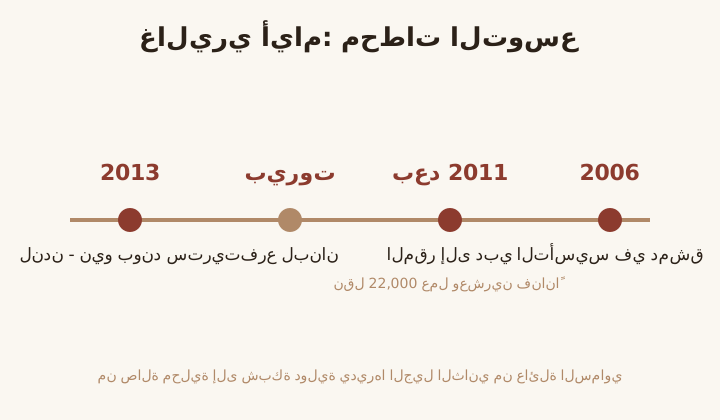
Twenty-two thousand artworks. That is what Ayyam Gallery moved from Damascus to Dubai over three years as the war intensified - along with twenty artists and their families, who left one after another to keep working from new studios. The Arab art market had never seen an evacuation on this scale, and it condenses the story of the gallery that turned Syrian art from a local scene into a global auction phenomenon.
The beginning: Damascus, 2006
When cousins Khaled and Hisham Samawi opened their gallery in Damascus in 2006, they were collectors before they were dealers. The bet was simple and bold at once: Syrian art was priced far below its value, and the gap between the talent of its artists and their international presence was a marketing gap, not a quality gap.
The gallery worked both fronts. Internationally: auctions, promotion and exhibitions abroad that put names such as Safwan Dahoul and Tammam Azzam in front of new audiences. Locally: the Shabab Ayyam program for discovering emerging talent, documentary publications, and educational programming. This formula - reaching the international market without cutting the roots - is what set Ayyam apart from every Arab gallery before it.
The great relocation
When the situation exploded after 2011, the Samawis took a decision that redrew the map of Syrian art: moving the headquarters from Damascus to Dubai, and moving the artists with it. From the Al Quoz studios in Dubai, the generation the gallery had taken in kept producing, and the war works - most famously Tammam Azzam's digital pieces - began reaching the world press within days of being made.
The expansion did not stop: Beirut, then London, where the New Bond Street branch opened in January 2013 in the heart of Europe's most exclusive gallery district. Showing a Syrian painting a few meters from Sotheby's, at the height of the war, was a statement in itself.
What does "internationalization" mean in practice?
Before Ayyam, a Syrian artist sold locally at local prices, and his works reached auction by accident. Afterward he had a published price, a documented exhibition record, and a presence at international art fairs from Dubai to Basel. You can see the effect in the auction numbers today: the record prices for Syrian modernists - from Louay Kayali to Fateh Moudarres - were built on an international collector base formed in those years. See the Syrian art scene after 2024 for how that translates into the current market.
The other effect runs deeper: the gallery preserved the continuity of an entire generation. The artists relocated to Dubai never stopped producing for a single day, while peers left without representation scattered across the exiles - a story told from its own angle in the diaspora scene in Istanbul and Berlin.
Ayyam today
The gallery today is entirely a family business, run by the second generation: Eyad and Maya Samawi. Programming runs mainly through Dubai, and the portfolio has widened from Syrians to Arab and regional artists. And with Damascus opening up after 2024, the natural question circulates in the scene: will Ayyam return to the city where it began? No official announcement as of this writing - but the Damascus galleries that held out inside the country await heavyweight competition.
The lesson Ayyam left the whole scene stands: Syrian art was never less than world-class - what it lacked was someone to build the bridge. Across that bridge later came the Atassi Foundation with an entirely different project - archiving instead of selling - and Sara Shamma, all the way to Syria's pavilion at the 2026 Venice Biennale. More in the articles index.
FAQ
Who founded Ayyam Gallery, and when?
Cousins Khaled and Hisham Samawi founded it in Damascus in 2006; they were art collectors before they were gallerists. Today the next generation of the family - Eyad and Maya Samawi - runs the gallery's operations from Dubai.
What is the Shabab Ayyam program?
A program the gallery launched to discover and nurture emerging artists through a competition, studio residencies and exhibitions. It produced several of the most prominent names of the young Syrian generation, who later moved on to full gallery representation and international auctions.
Where are Ayyam Gallery's branches today?
The main space is in Dubai (Al Quoz - Alserkal Avenue), with a historical presence in Beirut and a London branch that opened on New Bond Street in 2013. The most active programming today runs through Dubai.