Safwan Dahoul - Forty Years of a Single Dream
6 September 2026
A woman folded in on herself, eyes closed or extinguished, her shoulders wrapping a void shaped like absence. Black, white and gray, and a strict geometry that locks the body into a frame slightly too small for it. See one Safwan Dahoul painting and you will recognize the rest from the next room - and that is precisely his project: a single painting reproducing itself for forty years, titled Dream, its number changing while its question does not.
From Hama to Mons
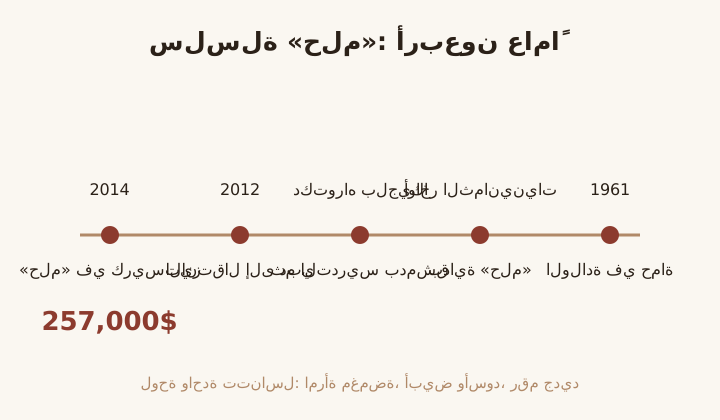
Dahoul was born in Hama in 1961 and trained at the Faculty of Fine Arts, University of Damascus, under the generation of the great modernists - the climate created by Fateh Moudarres and his colleagues was still the air every student in the faculty breathed. He then went to Belgium and earned a doctorate from the Higher Institute of Plastic Arts in Mons, before returning to Damascus to teach at the same faculty and become one of the pillars of its scene in the 1990s and 2000s.
The European years did not pull him toward pure abstraction. He came out of them with the opposite: an extreme economy of color, and the conviction that a single human form is subject enough for an entire lifetime.
His teaching years in Damascus made him, in turn, a link in the chain the pioneers had begun: a professor whose students passed through his studio as he had passed through his teachers', a fixed corner of the 1990s Damascus scene that was quietly simmering before the storm. Anyone chronicling contemporary Syrian art finds Dahoul at nearly every joint - teacher, exhibitor, then an exile carrying the whole scene in his suitcase.
Dream as autobiography
The series began in the late 1980s with a declared measure of autobiography. The sleeping, folded woman is less a specific person than an internal gauge: the more life closes in, the deeper she bends. In years of personal loss the paintings grew darker, and after 2011 the vocabulary of war entered without spectacle - no blood, no rubble, but a body ever more compressed and a space ever more sealed. Critics place the series among the most distinctive bodies of work in contemporary Arab art, and it is also the clearest connecting link between Syrian modernism and the generation after it.
In 2012 Dahoul left Damascus for Dubai with the help of Ayyam Gallery, part of the wave of departures of Syria's major artists, and continued the series from his Gulf exile. The Dream changed its postal address; its climate did not change.
How the painting works
Up close, any Dream reveals that the apparent simplicity is precise craft. The surface is built in thin layers that give the gray a depth no printed image ever conveys, and the female body is drawn with deliberate geometric distortion: rectangular fingers, an elongated neck, a closed eye like an arc. Many read this distortion as a dialogue with ancient Egyptian art and the murals of the Levant; others read in it the memory of the icon his generation inherited from the climate of Moudarres and his peers. Both readings hold at once, and that is one of the secrets of the series' pull: entirely modern and entirely ancient in the same moment.
Equally striking is the project's discipline. No loud colors begging for attention, no variety of subjects to please the market, no technical display beyond need. Forty years on what is nearly one canvas, and the result is one of the most recognizable signatures in all Arab art - you know it without the signature.
The numbers
Dahoul's market is among the most mature of any living Syrian artist. His record is 257,000 dollars for a Dream at Christie's Dubai in 2014, and his work appears regularly in the region's auctions - most recently Dream 72 in Sotheby's inaugural Saudi auction in February 2025, the same sale in which Louay Kayali broke the Syrian record at 900,000 dollars.
Two notes for the new collector. First, Ayyam Gallery is the primary channel for his new work, and the secondary market (Christie's, Sotheby's, Bonhams) is the documented pricing reference - always compare against published results, not talk; you will find the inventory in the most expensive Syrian artworks at auction. Second, the value of the series lies in its coherence; the large, resolved canvases from the peak of each phase lead the pricing over everything else.
His institutional presence matches his market presence: works in major public and private collections across the region, from the Dalloul Foundation in Beirut to Gulf museum holdings, and solo exhibitions in Dubai, Beirut and London running across three decades with barely an interruption.
Why this dream resembles us
Between the carved faces of Marwan Kassab-Bachi in Berlin and Dahoul's closed-eyed woman in Dubai there is a clear kinship: each condensed exile into a single body. And when Sara Shamma opens Syria's pavilion at the 2026 Venice Biennale, her generation will have inherited from Dahoul a lesson both simple and hard: repetition is not poverty of imagination but fidelity to the question that has no answer.
In the few interviews he gives, Dahoul speaks of the series as a necessity, not a plan: the next painting is born from a lack in the previous one, and the new number is only an admission that the dream is not yet complete. Hence our final advice for anyone standing before a Dream for the first time in a gallery or an auction room: do not ask what the painting means - ask at what moment of the life it happened. Its number will answer you.
The rest of the files are in the articles index.
FAQ
What is Safwan Dahoul's Dream series?
An ongoing project since the late 1980s: numbered paintings under a single title (Reve/Dream) built around a hunched woman with closed eyes in an enclosed space, in a palette almost confined to black, white and gray. The series is semi-autobiographical and deals with isolation, loss and waiting.
What is his auction record?
257,000 dollars for a Dream (Reve) canvas sold at Christie's Dubai in 2014, among the highest recorded prices for a living contemporary Syrian artist. Dream 72 was offered in Sotheby's inaugural auction in Saudi Arabia in 2025.
Where does Dahoul live, and which gallery represents him?
He left Damascus for Dubai in 2012 as the war intensified, with the help of Ayyam Gallery, which has represented him for many years. He still lives and works in Dubai.