A Century of Syrian Art - the Milestones That Matter
6 September 2026
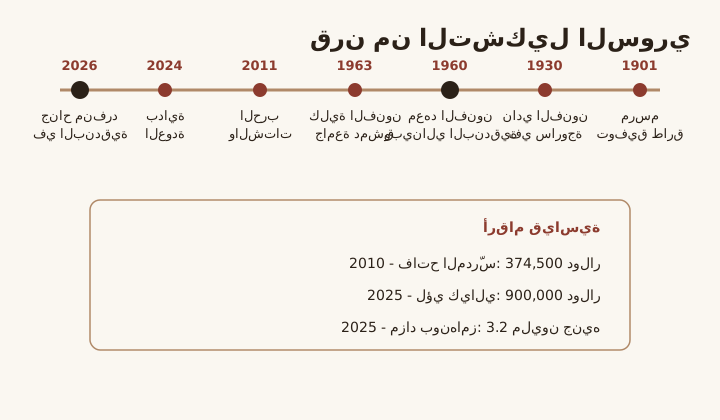
On 8 February 2025, at Sotheby's first auction on Saudi soil, Louay Kayali's Then What?? (1965) sold for $900,000 - a record for any Syrian artist. The painting was made in a country whose fine-arts faculty was barely five years old at the time. Between those two moments lies a century worth knowing, and this is its short map.
A studio in Ottoman Damascus
Tawfik Tarek (1875-1940) studied at the Ecole des Beaux-Arts in Paris and returned to Damascus after 1901, working as an architect and surveyor. His deeper legacy was his studio - the first independent one in the city open to the public. He painted the Damascene elite and historical scenes, co-founded the Fine Arts Club in Sarouja in 1930, and taught his city that a painting is a thing one buys. The generation after him worked with almost no institutions; academic training meant Cairo, Rome or Paris.
1960: the state builds the workshop
The Higher Institute of Fine Arts opened in Damascus in 1960, staffed initially by Egyptian professors, and joined Damascus University as the Faculty of Fine Arts in 1963. Mahmoud Hammad - later dean from 1970 - ran its engraving department and started the Baramkeh campus building. The full story is in the Faculty of Fine Arts article.
That same year, two young Syrians showed at the Venice Biennale: Fateh Moudarres and Louay Kayali. Both came home from Rome to teach, anchoring what collectors now call the golden decade - covered in Syrian modernism of the 1960s.
Names that became schools
Fateh Moudarres (1922-1999) flattened faces into icon-like rows carrying the weight of the northern countryside. Kayali (1934-1978) painted newspaper boys and fishermen in complete human silence. Hammad (1923-1988) turned the Arabic letter into abstraction years before "hurufiyya" became a regional fashion. Marwan Kassab-Bachi (1934-2016) left for Berlin in 1957 and turned the human face into landscape, ending his career as a professor at the city's academy of arts.
2011: rupture and diaspora
The war scattered the scene to Berlin, Paris, Beirut, Dubai and Istanbul, while others kept working inside the country. Tammam Azzam's Freedom Graffiti - Klimt's Kiss superimposed on a shelled Syrian facade - went viral in 2013 and became the image of the era. The chapter, from Youssef Abdelke's 2013 arrest to the exile biennales, is in Syrian art in the war years. Paradoxically, these were also the market's boom years: Moudarres set his $374,500 record at Christie's Dubai in 2010, and records kept falling through 2025.
After 2024: the return
Since December 2024 the direction of travel has reversed. Sara Shamma moved back from London to Damascus, then was chosen to give Syria its first solo national pavilion at the 2026 Venice Biennale with The Tower Tomb of Palmyra (9 May - 22 November 2026). The Damascus International Fair returned for its 62nd edition in August 2025 after six years. That new chapter is in the scene after 2024.
For a collector, three takeaways. Syrian art is institutionally young but dense - less than a hundred years separate Tarek's studio from the Venice pavilion. The Damascus faculty is the connecting thread behind nearly every name at auction. And the market lags the history by decades: the canon of the 1960s only hit record prices after 2010, which means entire generations remain underpriced. Browse all articles for the artist files and market guides.
FAQ
Who is considered the pioneer of Syrian modern art?
Tawfik Tarek (1875-1940). Trained at the Ecole des Beaux-Arts in Paris, he opened the first independent studio in Damascus accessible to the public and introduced the very idea of buying a painting to hang on a wall. He co-founded the Fine Arts Club in Sarouja in 1930.
When was the Faculty of Fine Arts in Damascus founded?
The Higher Institute of Fine Arts opened in Damascus in 1960 and was incorporated into Damascus University as the Faculty of Fine Arts in 1963. Most Syrian artists trading at auction today either studied or taught there.
What is the auction record for a Syrian artist?
Louay Kayali's Then What?? (1965), sold for $900,000 at Sotheby's inaugural Saudi Arabia auction on 8 February 2025 - roughly 150% above his previous record, Fisherboy, which made $341,200 at Bonhams in June 2024.