The 1960s - Syrian Modernism's Golden Decade
6 September 2026
Summer 1960, the Giardini in Venice. Among the pavilions of the major powers hang works from a country that did not yet have an art school: paintings by Fateh Moudarres and Louay Kayali, two young men from Aleppo studying in Rome and representing Syria at the world's most venerable biennale. That early appearance was the opening announcement of a full decade that changed the face of Syrian art - the decade the market pays for today in the hundreds of thousands of dollars.
Three conditions for the birth of a modernism
Modernisms are not born by accident. In 1960s Damascus, three rarely simultaneous conditions came together. First: the scholarship generation returned all at once - Moudarres from the Rome academy (where he studied from 1954 and won its first prize in 1960), Kayali from the same academy, and Mahmoud Hammad from his own early Roman period. Second: the state opened the Higher Institute of Fine Arts in 1960, giving the returnees a platform, a studio and students - its story is in the article on the faculty. Third: early international recognition, from Venice to the exhibitions of Beirut, then the capital of the Arab art market.
The result: within less than ten years, fully distinct visual languages crystallized in Damascus - languages any auction specialist recognizes today at a glance. They were not necessarily languages at peace with one another. The quarrels between the partisans of abstraction and the partisans of figuration filled the cafes and culture pages of Damascus throughout the decade, and that fertile rivalry was itself the fuel of the modernism.
Three languages from one city
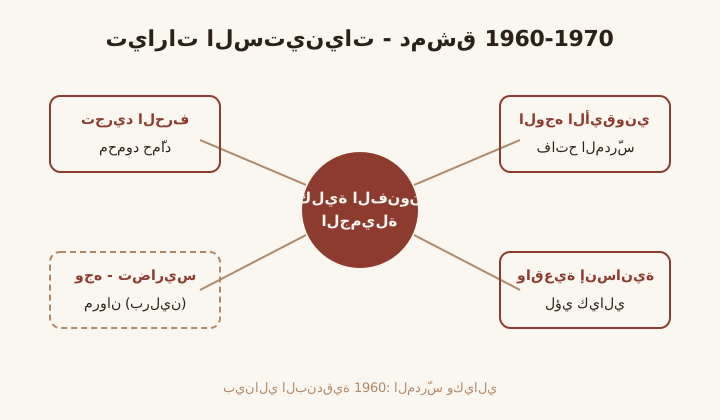
The iconic face. Fateh Moudarres (1922-1999) compressed faces into tight rows resembling the icons of Syriac churches, loading them with the clay and sorrow of the Syrian north. The son of the village of Hreitan near Aleppo never abandoned his rural roots even in his most abstract work, and he continued his formation in Paris into the early 1970s while teaching in Damascus. His 1960s paintings are the most expensive in his record: a 1967 work reached 374,500 dollars at Christie's Dubai in 2010, and for years that number stood as the ceiling of the entire Syrian market.
Humanist realism. Louay Kayali (1934-1978) went the opposite way: no abstraction, no symbol, but a newspaper seller, a fisherman, a shoeshine boy, painted with a silence that makes the canvas cry out. His painting Then What??, made in 1965 - the exact heart of the decade - is the one that sold on 8 February 2025 for 900,000 dollars at Sotheby's first Saudi auction, the highest price for any Syrian artist to date, surpassing his previous record - Fisherboy, painted in 1976 and sold for 341,200 dollars at Bonhams in 2024 - by about 150 percent. The market needed sixty years to grasp what the Biennale's visitors saw in that young man from Aleppo.
Letter abstraction. Mahmoud Hammad (1923-1988) found a third road: the Arabic letter not as ornament but as a geometric structure moving among squares, circles and fields of color. He arrived there gradually - from expressive realism in Rome, to early abstraction in Daraa where he worked within what became known as the Daraa trio, to his full immersion in the letter from the 1960s, before Hurufiyya became a broad Arab current stretching from Baghdad to Khartoum. Hammad remained the strictest of that movement's practitioners: for him the letter was structure, not slogan.
On the margins of the Damascus scene a fourth major figure worked far away: Marwan Kassab-Bachi, who had left for Berlin in 1957 and in the 1960s began the early figurative works that would later lead him to the face-as-landscape. His modernism was Syrian at the root even if it grew on the banks of the Spree.
A decade of institutions too
What is often forgotten is that the golden decade was a decade of administrative building as much as a decade of painting. The institute was folded into the University of Damascus in 1963; the Ministry of Culture created a Directorate of Fine Arts headed by Afif Bahnassi from 1962; official exhibitions and public acquisitions accumulated; and the artistic societies and associations multiplied, their threads running back to the Sarouja club of the 1930s, culminating in Damascus hosting the first Arab Congress of Fine Arts in 1971 - a symbolic crowning of a decade that made the Syrian capital a party to the Arab artistic conversation, not a recipient of it. Syrian art came out of the 1960s with what it had never possessed before: a faculty, a nascent market, and international names.
It also came out with a second generation forming inside the faculty's own halls: new teachers such as Nazir Nabaa, back from Cairo, and the students of the 1970s and 1980s who would carry these languages into new territory, foremost among them Safwan Dahoul - a complete chain of inheritance detailed in the faculty article.
Why does the market pay for this decade in particular?
The rule at auction is that value follows rarity and period. Syrian works of the 1960s combine both: they are the years of their makers' first maturity, and supply is limited because most settled into family collections and museums. When the Moudarres (1967) and Kayali (1965) canvases topped the price records, it was not nostalgia - it was precise pricing of the moment when Syrian art reached its maximum density.
The wider context is in a century of Syrian art, and what happened to this decade's heirs after 2011 is in Syrian art in the war years. More, as always, in the articles page.
FAQ
Why are the 1960s called the golden decade of Syrian art?
Because three conditions converged at once: scholarship students returning from Rome and Paris with modern languages, the opening of the Higher Institute of Fine Arts in 1960 which gave them a platform and salaries, and early international exposure beginning with the 1960 Venice Biennale. Most of the highest-priced Syrian works at auction today were painted in those years or branched from their styles.
Who represented Syria at the 1960 Venice Biennale?
Fateh Moudarres and Louay Kayali, both still more or less students in Rome at the time. Both returned afterward to teach in Damascus and became the most famous pair in the history of Syrian art.
What is Hurufiyya, and what is Syria's connection to it?
Hurufiyya is an Arab movement that made the Arabic letter a material for abstraction rather than decoration. Mahmoud Hammad was one of its earliest pioneers: from the 1960s he built his painting on the geometry of the letter within fields of color, before the movement became a broad Arab phenomenon in the 1970s.